
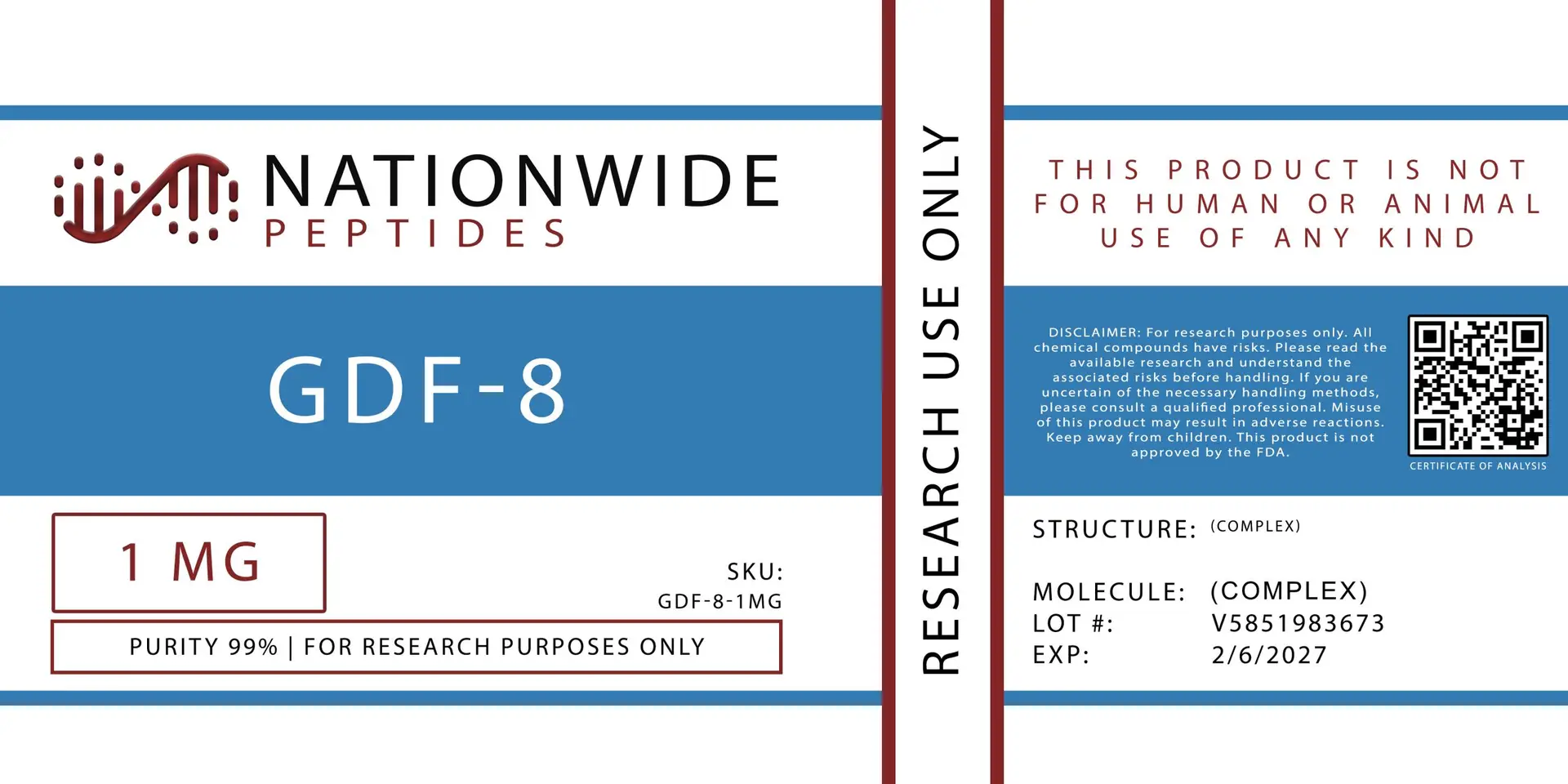





GDF-8 is a synthetic form of the endogenous growth differentiation factor 8, extensively used in preclinical research to investigate receptor binding (ActRIIB), downstream Smad signaling, muscle cell proliferation inhibition, and interactions with inhibitors such as propeptides or follistatin-related proteins. This research-grade peptide is produced under stringent GMP-compliant conditions and provided as a lyophilized powder to ensure superior purity, stability, and reliability in experimental applications.
Engineered solely for preclinical investigations, each batch of GDF-8 undergoes a comprehensive quality assessment and includes complete documentation, including a Certificate of Analysis (COA), purity data, and structural verification.
Scientific Overview
GDF-8 functions as a potent negative regulator of skeletal muscle growth by binding to activin type II receptors and activating the Smad2/3 signaling pathway in research settings. Preclinical investigations utilizing GDF-8 have examined the following mechanistic areas:
- Inhibition of myoblast proliferation and differentiation in skeletal muscle in vitro models
- Modulation of bone formation dynamics in osteotomy and fracture models
- Study of adipose tissue and metabolic signaling interactions in knockout models
- Investigation of musculoskeletal tissue interactions and cellular regeneration pathways in preclinical models
- Characterization of TGF-β superfamily signaling in muscle and bone cell systems
Why Researchers Choose Our GDF-8
For laboratories requiring dependable GDF-8 research peptide, our manufacturing process prioritizes reproducibility and scientific precision. Every batch is confirmed for:
- Purity ≥99% by HPLC
- Structural identity via mass spectrometry
- Third-party Certificate of Analysis (COA) available per lot
For Research Use Only. Not for human use.
Statements regarding GDF-8 have not been evaluated by the FDA. This product is not intended to diagnose, treat, cure, or prevent any disease.
Explore our testing protocols in About Peptides > Rigorous Testing.
Research-Referenced Functional Attributes (Based on existing preclinical and peer-reviewed literature data—not intended as claims of therapeutic use)
- Observed negative regulation of skeletal muscle mass through inhibition of myoblast proliferation and differentiation in rodent in vitro and in vivo models (DOI: 10.1038/387083a0)
- Expression detected in early fracture healing phases; deficiency associated with altered callus size and bone volume outcomes in osteotomy research models (DOI: 10.1002/jor.1100160307)
- Receptor binding inhibition by propeptide observed in cellular assay models, providing a tool for studying biological activity antagonism (DOI: 10.3109/08977190109029114)
- Signaling blockade via recombinant propeptide studied in musculoskeletal injury research models to observe effects on tissue response pathways (DOI: 10.1002/jor.21016)
- Altered osteogenic differentiation of mesenchymal stem cells observed in GDF-8 deficiency research models (DOI: 10.1002/jor.1100160307 related)
- Used in the examination of interactions with TGF-β superfamily members in muscle-bone coupling studies, as described by rndsystems.com and guidetopharmacology.org