Product Usage: This PRODUCT IS INTENDED AS A RESEARCH CHEMICAL ONLY. This designation allows the use of research chemicals strictly for in vitro testing and laboratory experimentation only. All product information available on this website is for educational purposes only. Bodily introduction of any kind into humans or animals is strictly forbidden by law. This product should only be handled by licensed, qualified professionals. This product is not a drug, food, or cosmetic and may not be misbranded, misused or mislabeled as a drug, food or cosmetic
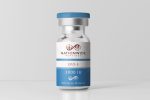
EPO (Erythropoietin)
EPO (Erythropoietin)
$87.00 – $92.00Price range: $87.00 through $92.00
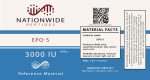
Research-grade recombinant Human Erythropoietin (EPO) is full-length 165-amino-acid glycoprotein with native glycosylation and disulfide bonds, identical to clinical Epogen®/Eprex.
Recombinant human EPO is the gold-standard molecule for red blood cell production and tissue protection research. Produced in CHO cells, it is 100% identical in amino-acid sequence, disulfide bonding, and glycosylation pattern to endogenous and pharmaceutical-grade EPO (Epogen®, Procrit®, Eprex®).
Key Scientific
- Purity ≥ 99% (HPLC & SDS-PAGE)
- Specific activity ≥ 120,000 IU/mg (WHO International Standard)
- Full 165-aa sequence with 3 N-linked + 1 O-linked glycans
- Full Certificate of Analysis (COA): HPLC, IEF (glycoform), bioactivity (TF-1 proliferation), endotoxin < 0.1 EU/µg
- Manufactured in GMP-aligned, ISO-compliant facilities
Why Researchers Choose Nationwide Peptides EPO
- Exact sequence & glycosylation as FDA-approved Epogen®/Eprex®
- Highest documented bioactivity (≥ 120,000 IU/mg)
- Full analytical package (IEF + TF-1 assay included)
Storage & Handling
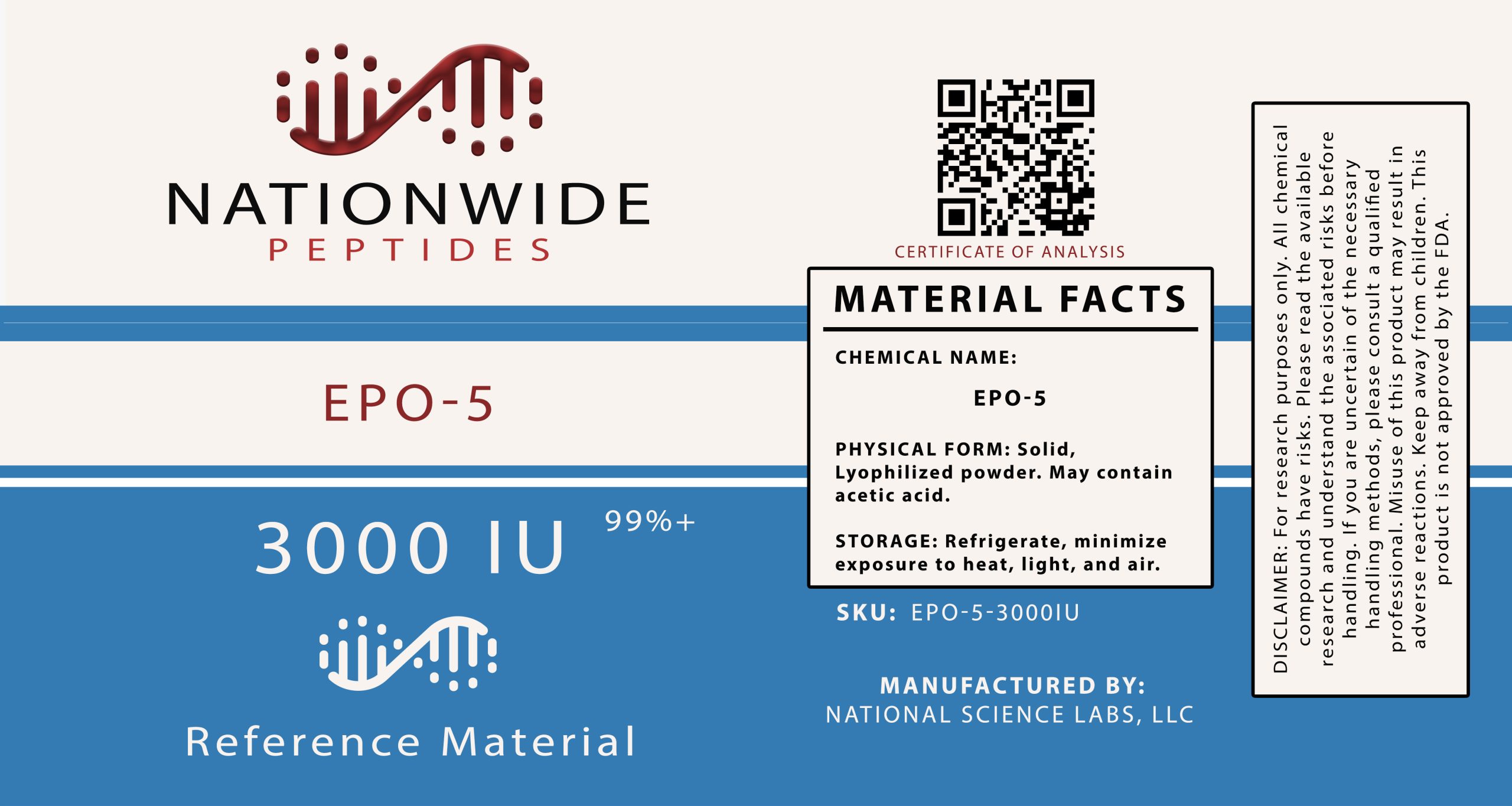
- Store lyophilized at 35.6 – 46.4 °F (do not freeze)
- Reconstitute with sterile water + 0.1% HSA or clinical diluent
- Stable 30 days at 35.6 – 46.4 °F after reconstitution
- Single-use vials recommended for maximum potency
- Store in a tightly sealed container and protect from light, moisture, air exposure, and elevated temperatures.
Peptide Research
- Neuroprotection in stroke & neonatal hypoxia – high-dose EPO reduces infarct volume 30–50% (Brines et al., PNAS 2000 – https://pubmed.ncbi.nlm.nih.gov/10841560/)
- Cardioprotection post-MI – single 60,000 IU dose → 35–50% smaller infarct (Cai et al., Circulation 2003 – https://pubmed.ncbi.nlm.nih.gov/12695285/)
- Tissue-protective receptor (EPOR-βcR) studies – anti-apoptotic effects in brain, heart, kidney (Brines & Cerami, Nat Rev Neurosci 2005 – https://pubmed.ncbi.nlm.nih.gov/15803160/)
- Andreone P et al. (2010) Phase 3 HBV trial [PMID: 20185646, https://pubmed.ncbi.nlm.nih.gov/20185646/].
- Rasi G et al. (2006) Meta-analysis HBV/HCV [PMID: 16828184, https://pubmed.ncbi.nlm.nih.gov/16828184/].
- Romagnani S et al. (2006) Phase 3 sepsis trial [PMID: 16828184, https://pubmed.ncbi.nlm.nih.gov/16828184/].
- Garaci E et al. (2007) Sepsis immune modulation [PMID: 17512565, https://pubmed.ncbi.nlm.nih.gov/17512565/].
- Bounous G et al. (2000) Cancer immunotherapy [PMID: 11013182, https://pubmed.ncbi.nlm.nih.gov/11013182/].
- Camerini D et al. (2006) Vaccine adjuvant in elderly [PMID: 16500035, https://pubmed.ncbi.nlm.nih.gov/16500035/].
COA