If you work in a lab, run preclinical studies, or manage procurement for a research facility, you already know that not all peptides are created equal. A peptide that looks perfect on paper can ruin months of work if the purity is off by even a few percent or the vial contains unexpected impurities. The difference between reliable data and wasted time almost always comes down to how carefully you evaluate purity and sourcing before you click “buy.”
Whether you are ordering peptide injections, injectable supplements, collagen peptide supplements, copper peptide injections, or any research-
grade compound, here are the practical, no-nonsense checkpoints experienced researchers use to separate high-quality material from questionable material.
1. Start with the Certificate of Analysis (COA) and Actually Read It
Every reputable supplier should provide a batch-specific COA. This isn’t just a marketing sheet; it’s the single most important document you’ll receive.
What a good COA must include:
• Exact peptide sequence and molecular weight (confirmed by mass spectrometry)
• Purity percentage determined by HPLC (High-Performance Liquid Chromatography) look for ≥98% for most work, ≥99% if you are doing sensitive receptor-binding or cell-signaling studies
• Full impurity profile (related substances, trifluoroacetic acid (TFA) levels, water content, acetate/counter-ion content)
• Solubility test results
• Date of manufacture and retest/expiry date
• Batch/lot number that matches the label on the vial
If the supplier only offers a “typical” COA or a generic one-page summary, walk away. Real research-grade peptides come with unique, detailed documentation for every single batch.
2. Understand the Two Main Purity Tests (and Why Both Matter)
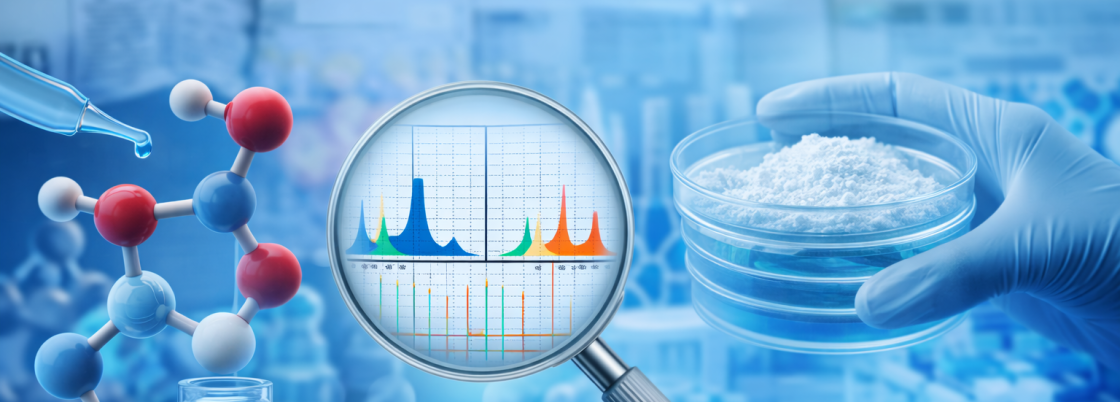
HPLC tells you how clean the main peak is, but it doesn’t catch everything. Mass Spectrometry (MS) confirms the actual molecular weight and
detects truncated sequences or deletion impurities that HPLC can miss.
Best practice: accept nothing less than both HPLC and MS data on the same COA. Many labs now require >98% by HPLC and correct
molecular mass within ±1 Da.
3. Ask for the Chromatograms — the Raw Data Behind the Numbers
Any supplier who truly stands behind their product will share the actual HPLC trace and MS spectrum upon request (redacted if needed for proprietary reasons). If they hesitate or say “we don’t release raw data,” that’s a red flag.
4. Check the Counter-Ion and Salt Form
Most peptides are supplied as acetate or trifluoroacetate (TFA) salts. TFA is fine for many applications, but if you’re doing cell culture work, high residual TFA can be cytotoxic. Some suppliers now offer low-TFA or acetate-salt versions specifically for sensitive assays. The COA should clearly state which salt form you’re getting and the residual solvent levels.
5. Look at the Supplier’s Synthesis and Purification Capabilities
Solid-phase peptide synthesis (SPPS) is standard, but the difference between 95% and 99% purity often comes down to the purification steps after synthesis. Ask whether they use preparative HPLC, ion-exchange, or other advanced methods. Suppliers who invest in multiple purification rounds and rigorous quality control are far more likely to deliver consistent material.
6. Verify Independent, Third-Party Testing
The gold standard is testing by an ISO/IEC 17025-accredited laboratory. Many top-tier suppliers send random batches to external labs for blind verification. If they can show you recent third-party reports (even redacted), that’s a very strong positive signal.
7. Packaging, Labeling, and Cold-Chain Discipline
High-quality peptides arrive in amber or opaque vials to protect from light, with proper desiccant, and inside temperature-monitored packaging.
The label should include:
• Full sequence (or at least the catalog number that links to the sequence)
• Net peptide content (not gross weight including salt)
• Batch number
• Storage recommendation (usually -20 °C long-term)
If your order shows up in a regular envelope with no cold pack, purity has almost certainly been compromised.
8. Amino Acid Analysis — the Often-Overlooked Confirmation
For longer or modified peptides, a full amino acid analysis (AAA) confirms the correct ratio of each residue. This is especially useful for detecting
racemization or deletion sequences that MS might miss.
9. Endotoxin Testing for Cell-Based Work
If you are doing cell culture, organoids, or in vivo studies, ask for endotoxin levels (reported in EU/mg). Reputable research suppliers routinely keep endotoxins below 1 EU/mg, often <0.1 EU/mg.
10. Transparency About Modifications and Conjugations
Many advanced studies use biotinylated, fluorescent, or lipidated peptides. The COA for these should clearly show the modification site, degree
of labeling, and free (unconjugated) peptide percentage. Lack of clarity here is a common source of experimental variability.
11. Supplier Track Record and Scientific Support
Look for companies that:
• Publish white papers or application notes
• List real scientists you can contact with technical questions
• Have a history of supplying major universities, CROs, or pharma companies
• Offer reasonable minimum order quantities and fast re-supply for ongoing projects
A supplier who only sells retail vials with flashy marketing and no scientific backing is rarely the right choice for serious research.
12. Price vs. Purity Reality Check
Ultra-cheap peptides are almost always low-purity crude material. As a rough rule of thumb:
• < $2–3 per mg → usually 70–90% crude, not purified
• $4–8 per mg → typically 95–98% research grade
• $10 per mg → often 99% + with full analytical package
Paying a little more upfront for verified purity saves enormous time and money downstream.
13. Red Flags to Watch For
• No COA or only a one-page “certificate”
• Purity listed as “>95%” without specifying the method
• No batch number on vial or paperwork
• Supplier refuses to share raw data
• Overnight shipping with no cold pack
• Overly aggressive marketing claims
• Website focused on consumer wellness instead of research applications
Any one of these should make you pause and dig deeper.
14–19. Questions to Ask Your Supplier Before You Buy
Experienced procurement teams use this checklist:
14. Can you provide the full HPLC and MS for this exact batch?
15. What is the endotoxin level?
16. Which salt form and residual TFA percentage?
17. Do you perform third-party testing?
18. What is the net peptide content (not gross weight)?
19. How is the peptide shipped and stored before dispatch?
If the answers come quickly and confidently, you are probably dealing with a solid partner.
Putting It All Together
Evaluating peptide purity and sourcing doesn’t have to be complicated, but it does require discipline. Treat every purchase like you treat your
experimental design with attention to detail and zero tolerance for shortcuts. The right peptide, properly verified, becomes an extension of your
protocol. The wrong one becomes a variable you’ll spend months trying to control.
Choose Nation Wide Peptides for Research-Grade Peptides You Can Trust
At Nation Wide Peptides, we supply only high-purity, fully documented research peptides backed by complete analytical packages (HPLC, MS, AAA, endotoxin when requested). Every batch comes with a detailed, batch-specific COA, temperature-controlled worldwide shipping, and direct access to our scientific support team.
Whether you need standard catalog peptides, custom sequences, or bulk quantities for long-term projects, we are built to support serious research reliably, transparently, and consistently.
Ready to simplify your peptide sourcing? Visit Nation Wide Peptides today and request a quote or download sample COAs. Your next breakthrough deserves
materials you never have to second-guess.